 From Wikipedia:
Interactive TV
Enhanced TV and Media multitasking
Internet TV and Digital TV
Enhanced TV.com
Enhanced Tv at ensequence.com
Image above right: enhanced tv for a Gorillaz video on MTV.
 From Wikipedia:
Teletext regular service
There's a bit more on the BBC's interactive TV services here. Image from here.
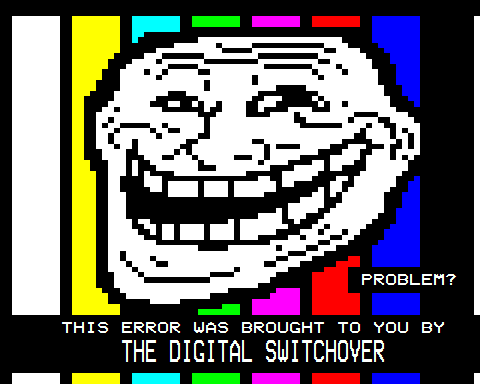
 Fault screens interest me, particularly this one, a full text warning sign from Melbourne, Australia.
 This one, from Malaysia, attempts to create some interesting filler in place of regular transmission.
 Finally, this screenshot is of the 'in-vision' function Teletext provides/used to provide, demonstrating a somewhat dying medium. However, as the screenshots below show, the function is not fully lost, rather recontextualised, often to a more aesthetically pleasing extent:


Sources:
http://teletext.mb21.co.uk/
http://www.tkk.fi/Units/IDC/brocom/sub/terminal/abstract.html


 Above image created with MacOSaiX, a piece of software that can be used to create mosaics.
 An ASCII representation of Ferrari's prancing horse logo.


The above movie also incorporates explanatory text alongside the typically 90s graphic styling.The below one, (mainly a musical piece) however, is more reminiscent of 80s computer graphics:
 About Jodi's Teletext series - "Bastard-ASCII"


 Art Typing, Nathan Krevolin, 1962 - excerpts
 Early ASCII art was spread via e-mail, bulletin boards and other online activities, such as in MUDs (Multi User Dungeons). This page from the earlier days of the Internet explains ASCII art briefly and a number of 'artpacks' to download. The site's design is also typical of the early days of the Internet, being rather primitive with jagged, brightly coloured graphics.
 Whilst there is no doubt ASCII and ANSI art is on the decline somewhat in comparison to the early Internet, I would tend to disagree with this - it seems to be sensationalism on Bill Gates' part. Maybe because of its synonymous links with the Internet as well as its existence as a creative and distinctive artform, the medium survives today.
 Wikipedia Entry
 Today, the medium is used for more elaborate creations such as webs comics, as in this example, animations, as demonstrated here and even desktop art (example here). In the example above right, some block ASCII is shown in two different font sets, demonstrating the slight difference across formats. This makes it less compatible than photographs with regards to consistency. The block method, however, allows for more intricate and smoother-looking art whilst retaining the jagged edged pixellated look characteristic of the medium.
 http://en.wikipedia.org/wiki/ASCII_stereogram
 http://teletext.mb21.co.uk/gallery/extra/11-Sep-2001.shtml
 In the UK, all services currently are using, and have pretty much always used, Level One encoding. However there have actually been advances in the technology, significantly improving the graphics to look smoother. On a large scale, this has never really caught on, however, with only a select few services choosing to employ Level two. This excerpt addresses this issue:
 "But nobody reads teletext, it looks crap" some might say
  With many people suggesting that Teletext is slow as it is, Level Two teletext was what the service was supposed to go on to become, and in many ways was a precursor to the digital TV teletext technology we see today.
 What is the future of teletext?
 In addition, this service seems to be more efficient than traditional teletext. By pressing left and right keys one can scroll through the pages at one's own leisure and the up and down keys highlight the three-digit codes on the screen to be selected. There is still the option of entering a three digit code using the keypad however. The user still have to wait for the pages to load, which is quite time consuming. There are also mix and hold options but I still haven't found the button to make the text larger.


 Sometimes this stuff is more interesting than the actual content of Teletext today.
 Some elements of teletext become so popular that they make the transition from a large teletext 'community' to a credible Internet one. The above examples, all from Channel 4's Teletext service, developed a cult following on the teletext format and, with the traditional format's decline, the Internet serves to continue the 'legacy' they have left. In the case of Mega-Zine, it was taken from the broadcast before being 'brought back by popular demand' but only on the Digital format of the medium - Teletext Digital.

Note the animated Gif showing the advertisements switching between frames, one possible conversion of the format for the web. Pro - remains faithful to the original format, is quicker. Con - not really interactive - no hold button.
 A couple of questions concerning teletext and/or its functionalities in the forthcoming analogue shutdown, from the Freeview FAQ link above:
 The first of these displays one or two elements that will be lost from the traditional teletext system. The 'mix' mode, whilst debatably useless, was a hallmark of teletext upon its inception. However nowadays there is less use for this function apart from with subtitles. Maybe in time this will be incorporated into the newer digital boxes but at least in my opinion the white text on the black background is far easier to read, despite its obstruction of more of the viewing area.