Welcome, teletext fanatics! I'll just leave this here...

Showing posts sorted by relevance for query lektrolab. Sort by date Show all posts

Friday, 27 April 2007

Teletext - research

http://blog.wfmu.org/freeform/2006/01/teletext_the_or.html - Teletext - early Internet?

http://projects.lektrolab.com/microtel/index.htm - Microtel - 'teletext revived'

An idea for a future project - a Teletext creator in flash. People can submit their own pages to be broadcast on a group text 'station'. A backward progression to the early days of the Internet and its predecessors. I could see the outcome being appealing to retro fans.

This page demonstrates some of the pixel art that once appeared on Dutch teletext service VBI Microtel. This brings in aspects of pop culture and some art has a political message. Other pages are there just for fun. The one shown to the right featuring George W Bush is my personal favourite. Doesn't really serve any particular purpose, it's just a good piece of pixel art.

Sometimes even the scrambled mess caused by poor reception can result in an interesting piece of 'art' in itself. Perhaps a teletext random garbage generator might be an option for the idea stated above?

Cebratext 1.1
http://projects.lektrolab.com/microtel/technical_information.htm

After a bit more digging, found a piece of software similar to the project I mentioned earlier in the post. After a little fiddling, I can't really work it very well - it takes some getting used to. I presume this is very similar to the stuff they actually use to program teletext to be broadcast on TVs. It isn't very user-friendly, however: takes a while to get the hang of things, as may be evident from the screenshot above displaying my lack of progress with the thing.

Monday, 5 November 2007

Some proposed chapter headings

Here are some rough headings for possible chapter sections, along with approximate dates. This assumes the project will be in essay format. Subjects I am more interested in will take the form of case studies rather than just a paragraph or two worked into the main body of text.

Intro - Technical/history
  1. Teletext's invention and inception (1970).
    1. Background: other digital media around at the time: arcade video games, links in commercial popularity and aesthetic. 1972 - Pong becomes widely popular, 1976 - teletext launched. ARPAnet in America - primitive early version of the Internet. Functionalities.
    2. Aesthetic. 1974: the 40x24 character grid was agreed upon, including text and a few graphic characters for creating simple graphics. The constituent media of 'teletext' - Teletext and Viewdata.
Sociological
  1. Teletext's growth in popularity
    1. 1990s - firmly in public conscience.
    2. Teletext and television.
      1. Television sketch parodies - Alexei Sayle.
      2. Pages from Ceefax.
      3. Case study: Tom Moody's 'Dallas' project (1990). Teletext as an extension of television, a text version of the medium. Comments on television and society
      4. 1997 - teletext spreads to satellite. Small case study - Data Design commercial teletext design - MTV teletext.
  2. Pioneering: the medium's status as first commercially successful digital information retrieval method. Bringing technology to the masses through limited set of aesthetic restrictions.
  3. Teletext's service - uses. Simple games. Information service. Accessibility tool - subtitling.
    1. Case study: functions as compared to (early) Internet - Viewdata's crude email system; reader view pages - use of teletext pages as discussion forums etc. How the two mediums never genuinely converged.
Coexistence/crossing of mediums
  1. Internet growth in popularity (1990s).
    1. For the 1990s, coexisted with teletext.
    2. 2000s: Internet begins to take over.
  2. Teletext adapted for the web browser.
    1. Jodi's 'text' piece.
    2. Carola Unterberger-Probst: 'Framed'
    3. Encoding to receive analogue teletext via net.
  3. Teletext's expansion worldwide (1980s)
    1. Ceefax grows from 30 pages in 1973 to 600 in mid-80s. Spread to France, America in early 80s.
    2. Along with Atari home console, propagating the 'jagged pixellation' aesthetic. Paul Slocum: Atari > windowed GUI.
Death of the traditional aesthetic
  1. From first analogue aerial switch off in 2007 to the complete switch off in 2012.
  2. Differing public opinions - "sad to see it go", "natural progression of technology would see it die out".
  3. Introduction of digital TTX and later Interactive TV - an evolved form of the traditional analogue version. 'Sounding death knoll' of the traditional aesthetic.
  4. Level 1 and 2 teletext upgrades - how these relate to modern 'digital teletext' in terms of aesthetic. The 'stepping stone' between teletext and digital teletext.
Future of traditional teletext
  1. It would seem the traditional format is doomed but the very medium which could see it die out would be the one allowing it to live on after the analogue switch off, namely the Internet.
  2. Estonia - still the No.1 method of information retrieval ahead of the Internet. Tarmo Tanilsoo's tribute websites.
  3. Case study: Lektrolab - 2006 Microtel project. People still using teletext aesthetic to create art.
Some conclusions
  1. Despite sharing a number of functions, Teletext is not really the predecessor of the Internet, more a separately evolved medium with some similarities. Whereas the ARPA network developed in America teletext was more a British invention and, even though there were signs they might with Viewdata, at no point did the two converge.
    1. Maybe a simple diagram showing the two separate 'evolutions' could explain this point.
  2. The teletext aesthetic survives?
    1. Later, the Internet allowed for enthusiasts to create homages to the medium. To date, there are over 500 worldwide terrestrial teletext services available on the Internet. This could be the medium that sees the aesthetic live on, even after the analogue version is gone.
    2. The mobile web browser as having similar technical/aesthetic restrictions.
    3. Lektrolab's project shows there are still those who value the aesthetic as a medium for artistic expression. Eboy shows that the pixel as an aesthetic is still in the public's conscience in the fact it still has commercial value (brief mention of Eboy, not worth going into great detail over).
    4. Services such as Digitiser, even after they were taken from terrestrial screens, adapted to the online format (Digiworld). Fan sites.
It might be worth having an appendix with some of these timelines in them to help illustrate. Perhaps these could be written timelines as in Internet Art by Rachel Greene. Should the medium of the outcome facilitate it, include with/alongside the text/content.

Cross reference sections in some way.

Monday, 8 October 2007

More about Lektrolab

Lektrolab are a Dutch multimedia company. They often work with the Cebratext editor to create teletext art. They have a Flickr photostream, which they post their own and other peoples' submissions to. I have picked a selection of the best teletext art from.


Some of these I actually visualised as rough ideas for my own teletext system. I may decide to create my own versions of these or actually reproduce these as part of the overall HTML navigated piece.

The Google one in particular I have considered at least once: its simplicity lends itself to the teletext format. It looks a bit like what Google on a teletext phone might look... interesting transcending of mediums.

The Space Invaders piece was another idea, as was Pac Man and other video game icons. Perhaps these could be modern ones in 3D, like Super Mario or Donkey Kong, taken 'back in time' to their roots in early arcade games with pixellated graphics.

I will look to examine some of these submissions further and maybe consider using them in my final outcome, whatever it may be.

Wednesday, 16 January 2008

More glitching


Some teletext glitch art by Paul Davis of Lektrolab and a piece by a user with an unprintable name at Flickr.

Monday, 21 January 2008

Misc. links

  • Video cards were originally much the same resolution as teletext. However whilst Video cards advanced teletext's format remained the same.

Wednesday, 5 December 2007

Teletext specifications - links

Information on the general specifications of teletext pages.

Monday, 1 October 2007

Teletext artists, compiled

There are a selection of artists that could be termed 'teletext artists'. Here are some of those that have utilised teletext as a medium for art, previously examined in this blog compiled into a list.

Friday, 19 October 2007

Action plan

A series of to-dos and stuff to be explored:
  1. Select information/images from blog to be presented. Convert into text format (traditional essay format?):
    1. Pixel artists. Jodi. Probst. Lektrolab.
    2. Teletext historical timeline. Invention. Initial implementation. 2012 switch off.
    3. Teletext and the internet/video games/other media. Connections between teletext's functionalities, aesthetical restrictions and other similar methods of presentation.
  2. Select a medium to convert the material to.
  3. Rewrite/format information for the selected presentation medium. For example, if it were teletext, cut it down into one or two sentence paragraphs and reword it to be precise in as short a way as possible.
  4. Work the aesthetic around this.
Raw text > Essay format > Proposed outcome format

Friday, 18 January 2008

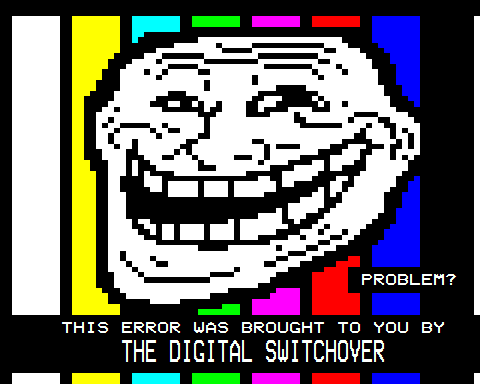
More teletext humour


Friday, 19 October 2007

Project aims

Thought it might be good to reassess the original aims of the project and how I am progressing towards finding conclusions. Wrote these up. Most of this went into a project evaluation form:

Reached some good concepts for final outcomes, such as recontextualising existing information broadcast systems for a more technologically advanced age, for example, how the aesthetic of teletext would be transmitted via mobile phones, computers or even HDTV.

Done some fairly basic experiments for outcomes. These include exploring the possibilities for converting the medium of teletext to the digital form, in particular the web browser. Experimented with Flash, HTML and the Cebra Teletext editor to create a (and use the) visual aesthetic.

An initial project aim was to find out to what extent teletext was a precursor to the internet. I researched early web networks, video games and other similar media and found that teletext was in fact the first commercially successful electronic public information retrieval system. Thus, teletext and its functions and methods were influential in the early days of the web even if the aesthetic, which was largely determined by the medium, was not. In other ways, though, teletext remains unique. For example, the number entry page navigation system has not really been emulated by any subsequent technology.

A second aim was to look into some of the artists that use teletext as a medium for producing work. Found that this method is much more popular in Europe, where teletext is still a priority. Lektrolab’s user submissions project was a good example of this, with the general public creating their own teletext pages for transmission on Dutch teletext. Enthusiasts extend the reach of the medium by creating home made teletext systems for their website, such as Tarmo Tanilsoo, who uses the web browser as a teletext browsing tool by emulating the format.

In addition to this, artists still allude to pixel design, and look to utilise the idea of ‘extreme pixellation’ due to its distinct aesthetic and recognisibility. There is also an element of nostalgia in some cases – many will be sad to see teletext in its traditional form, with its traditional asthetic die out.

Finally, for the conceptual/historical aspect, I have a greater understanding of the historical timeline of the medium, from its inception in the 1970s to the switch off in 2012. In the UK, the medium ‘survived’ technological updates due to accessibility problems with level 2 and level 3 teletext, but also because people continued to use it as their main source of information.

Things are going along pretty much to plan with regards to the project. The weblog is providing a useful resource to compile and organise data. As an addition, the microsite has been a useful way of testing out presentation methods, albeit within the HTML browser restriction.

I now need to select information from the weblog and decide how it needs to be presented. With regards to this, I have a range of options open to explore further. From these I will choose the most appealing to develop into a project.

Monday, 29 October 2007

Selection of information

Info collected in this weblog organised into some headings. Some of the more important stuff.

Teletext technical history
  • Conception and invention of medium.
    • Early 1970s. Developed and created by the BBC, who were initially researching a method of closed captioning.
  • Technological updates/upgrades
    • Mid-1970s update to include 8 colours.
    • Level 1.0 and 2.5 teletext - more updated graphics but not used by any TTX broadcaster in Britain.
  • Significant dates and events in TTX's technical history.
    • 1980 - Pages From Ceefax first broadcast. 2005 - service ended. (Case study for the lifespan of the medium?
    • Relaunches and redesigns. 1996.
    • The birth and death of teletext. 2012 switch off, gradual phasing out of the medium.
Constituent media
  • Teletext
    • 'Ceefax' (BBC) coming first in 1973
    • 'ORACLE' (ITV) following soon after
  • Viewdata - Post Office's method of transmitting text via telephone lines. 'Prestel'.
  • The teletext umbrella.
    • Collaboration of Ceefax, ORACLE and Prestel to create the collective term teletext, 1976 - 'Broadcast Teletext Specification'.
    • The single aesthetic which was agreed upon - 40x24 grid of text with some graphic characters - CEPT1.
  • 1980s - Videotex. Minitel - TV with computer keyboard incorporated used to control. Not adopted in Britain.
Similar media (chronlogical?)
  • 1960s. ARPANET. Information retrieval service/communication method. Early network. Precursor to internet.
  • Late 1960s. Arcade video games. Precursor to teletext.
  • 1970s. Development of the computer GUI. Similar aesthetic to teletext, pixel medium. Moved away from this similarity, however.
  • 1990s. The early Internet. Transmission of plain text information. Few images.
  • 2000. Internet boom. Teletext and internet - comparisons/contrasts.
  • 2000. Interactive television - successor to teletext. Retains many features/functions
    • Function of each medium, with regards to teletext.
Societal impact
  • Popularity.
    • First electronic information retrieval system.
    • Regular updates at the peak of its popularity.
    • Sep 11 01 attacks - when Internet down, TTX provided people with service. Probably last thing TTX will be known for.
  • Uses.
    • Transmitting/finding information - pools news, lottery, football results.
    • Playing games. Bamboozle multiple choice. Quiz questions - reveal button.
    • Discussion 'forum'. Viewer opinions on music, TV, entertainment etc.
    • Closed captioning method to aid hard of hearing.
  • Peoples' opinions on the phasing out and subsequent 'death' of the medium.
    • Sad to see it go. Nostalgic reasons, preference - simplicity.
    • Many don't use it anyway. Internet and interactive TV used instead. 24hr news channels.
  • Teletext humour.
Teletext art
  • The teletext aesthetic emulated within the internet browser
    • Jodi - 'Text'. Teletext style font set formatted for web browser.
    • Unterberger-Probst - 'Framed'. TTX aesthetic emulated and embedded into web browser.
    • Tarmo Tanilsoo - ES5DWXL. Personal web site. TTX aesthetic emulated and embedded into web browser.
  • Work broadcast on teletext
  • The pixel - works that share a similar pixellated aesthetic.
    • Paul Slocum - Windows GUI formatted for Atari. Use of Atari emulator.
    • Cory Arcangel - Landscape series, video game art. Pixellated aesthetic similar to teletext.
    • Eboy - Pixellated aesthetic borrowing from Sim City video game idea/aesthetic. How contemporary artists use the pixel aesthetic originally employed by teletext as a commercially successful format.