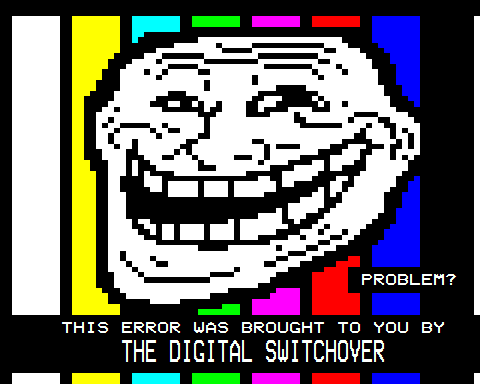
Welcome, teletext fanatics! I'll just leave this here...

Showing posts with label websites. Show all posts

Tuesday, 15 January 2008

Paul Slocum/Cory Arcangel

Paul Slocum's website

I mentioned Paul Slocum in an earlier post when I wrote about his Atari Windows GUI. A lot of his work focuses on video game hacking, particularly through music. One particular piece, Combat (right), was actually exhibited at the 2004 Liverpool Biennial. It's another hacked cartridge in which the music is all glitched up:

Combat, 3 mins

I've never played the game before but in this version, the exisiting soundtrack is replaced by a house/garage/whatever funky soundtrack!

Cory Arcangel's website

...is fashionably unfashionable. Actually, I like the design better than most websites...

There's some interesting work on there, mostly conceptual but there's a long tutorial on how to recreate the 'clouds' piece, if you can get hold of a Nintendo.

Notice the great big chip pasted to the cart to modify the programming. It would have been much easier (but less fun I expect) to hack a ROM using computers... but that would probably be illegal, I suppose.

Glitch browser

Glitch Browser

This is a little computer application that corrupts any page you input to the address bar. It works in your browser like any other, except everything is all messed up. Auto glitching, kind of. The above image is a small screegrab from my Teletext album on Flickr. I used to get a lot of glitched images similar to these when I used floppy disks but sadly nobody uses them any more - probably for that reason.

Befix - glitch art

"Pleasure is Error". For some reason humans (particularly us British) like seeing things go horribly wrong. Not in a mean way but kind of accepting failure.

I always laugh when my cable box crashes, making voices become zombified and the screen display a nice little pattern. Befix is a website inspired by computer display glitches.

The glitch section is quite interesting, I feel. There's a variety of imagery which seems to be generated using different formats. It would be good to take a variety of video appliances and see how I could corrupt them - starting with my cable box and moving onto teletext pages, video game consoles, computers etc. Maybe a side project would be a 'glitch' blog.

Monday, 10 December 2007

Ceefax.tv


The design for ceefax.tv is plainly and blatantly ripped from Google's. From what I can gather the two are not connected in any other way than the ceefax.tv search engine matches Google's, page layout wise.

And what better way to apply a search engine to a teletext system? It knocks the socks off the old Telesoftware search function (maybe, depending on your opinion) because it's much more advanced. That said, the premise is very simple: enter a keyword and you get some results grabbed from the teletext service that day. So, if you can't be bothered looking through the number entry menu for, say, Gordon Brown, just put his name into the search engine and you get a bunch of news stories. You can also use the traditional three-digit method if you like. The latter brings the page straight up in a popup window which inlcudes some clickable hyperlinks.

In other words, this is a Ceefax website. This is the opposite of a Google webpage put into teletext (right). I wonder what the web would be like if it were all teletext? Not being old enough to remember, let alone use, Viewdata, I can only imagine. Would be an interesting project to transpose some famous websites (such as Google) into the teletext aesthetic.

Monday, 15 October 2007

Looks like I've got some competition

Seefacts.co.uk

Found this site whilst trawling the Internet today. Tom's blog is formatted as a teletext page - only a bit more advanced than my homage.

Aesthetic aside, I dunno how he got that teletext-style font to be embedded into the page. I see that he had to use Courier for the heading, as I did with my original microsite design. Doesn't seem like there is much content at the moment so I don't know what his intentions are. Maybe he designed the ttx font especially for the site? I did download it but haven't tested it yet.

Looks like he had some fun designing his own graphics, too, though some of them need a bit more work, maybe. On the whole, it works. Something to take and develop.

Update, 19/10/07:

Emailed Tom asking for some more info on his blog and maybe some sort of sharing of material if, indeed, his blog will be based around teletext.

Home made teletext

Teletext, it would seem, is still very popular in Estonia. Tarmo Tanilsoo, the creator of this website which I have mentioned in an earlier post, has uploaded a video to YouTube. It contains some experiments he made in creating a home made teletext system, formatted in 'Pages from Ceefax' style:

Though experimental, this is really cool. I love the graph - maybe I could do something similar for results of my questionnaire?

Elsewhere, I found this site he also created. It is similar in navigation structure to the other mentioned site, but is in Estonian so I don't know what's going on most of the time. Seems like it also used an embedded Javascript code to navigate pages.

Teletext Holidays

Maybe it was inevitable but the Teletext format as was known for many years is not employed by Teletext in their online presence. Even in 1996, there weren't many allusions to the television broadcast format aside from the heading which was the same as the actual logo on Teletext, an example of which is shown right, a Christmas themed version (note the animated GIF format, very popular in the mid 90s).

Here is an early warning to people that Teletext is to be phased out in favour of 'cooler', more up to date technology. From 1997, when not many people had access to the Internet.

Above is what Teletext predicted interactive TV to look like. Note the iconic still-pixellated logo which was used by the company at the time. Compare this to the modern website and its new logo, revamped for a post - teletext age:

There are obvious allusions to the web format rather than traditional teletext in the new version. I like the > arrow selection < idea which is a reference to pre-programmed television interfaces and video game selection screens. I am still not sure about the purple gradient background though and would take the old version over the current one.

Monday, 1 October 2007

Teletext and the Internet revisited - part 2


The formatting of web pages into browsers is nothing new. This website by Tarmo Tanilsoo is a Javascript homage to the traditional teletext format. Even though the site is not content-heavy, the aesthetic and format are relevant and intuitive. The only real difference I can see is that it seems to be a lot quicker than 'real' teletext...

The pages are a series of GIFs created in an external editor, presumably Cebratext. The Java seems to be a small link applet which quickly loads pages into the cache.

It's a personal website with some appealing art (shown in the screenshots above). An integral part of this is conveying the weather in his home town in the form of graphs, images and maps.

Overall I really like this site. It's no-nonsense pure teletext homage, modified for the modern browser. Lots of inspiration I can take for my project - it's funny how 'outsider' teletext art is often the most impressive.

And finally...

Here is a website with links to teletext services around the world.

Here is another small piece of teletext art created by Tom Moody, made with Cebratext.