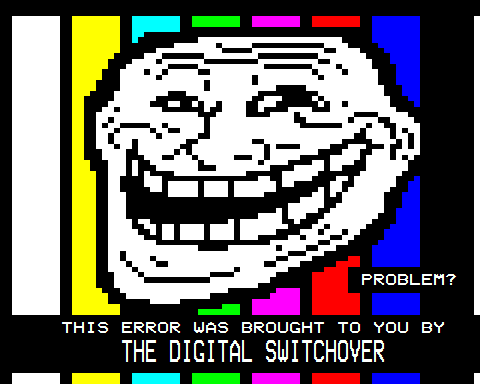
I've wanted to post about this for a while but I couldn't get my teletext capture software to run through the cable set top box. Instead, I resorted to taking pictures.
Paramount Comedy is a channel that broadcasts on Sky TV. Like many other satellite channels, it used to have a full working set of teletext information pages, including TV listings and an irreverent user feedback page. Now, the pages are no longer updated but still exist in a form untouched since they couldn't be bothered with the service any more. Included in these are some rather interesting technical and humorous pages, such as ones depicting cats and penguins.
Tuesday, 30 October 2007
Monday, 29 October 2007
Who broke my teletext?
Working on the idea of glitches, I produced a quickly shot and edited short film based around teletext scrambled receptions. Other areas I could expand to would be snow and test cards, but for now I think the glitch idea has some mileage at least.
I may develop this but it's just a test, really. Maybe I could take the idea and develop it for the web browser much like Jodi have in their Text piece.
Cory Arcangel
Cory Arcangel is apparently part of the video game art community - a bit more research reveals that he is a bit more well-known than I first thought.Cory Arcangel, Amazon entry
To start, he has a book. It's 'a hacker's nostalgia trip' documenting some of his (and his fellow programmers' activities).
More info on the book.
Here's a page of some of his exhibits, including the Landscape series projected in exhibition environment. The image to the right is one such installation, and includes his video game 'I Shot Andy Warhol'. There's a video of this on YouTube:
I just found it simply awesome. The pixellated version of Colonel Sanders is particularly brilliant.
I'll leave this post with a nice, relaxing GIF of Arcangel's. According to Uncyclopedia.org, it "is the world's 3rd most seen .GIF file off all time after LOTR.gif and POO.gif."
A teletext timeline
From some of the data and information collected in this weblog, as well as some more added specific research (details below), produced a timeline of events. The top section describes major dates in the history of teletext whilst the bottom one describes major events in other related media. I'm going to work on this some more, I think.
Some extra sources:
Digiworld - teletext archving
With the Internet and interactive TV set to supersede teletext, the pages of teletext will become history. However some enthusiasts have brought the format to the Internet. Digiworld is one such cult section, which made the transition online from the original 'Digitiser' part of Teletext's service. It seems this is new content formatted in the traditional manner. You can download an archived version of the service which is pretty extensive with over 1,500 pages.This is one example of people making the move from a teletext collaborative service to one based online. The content remains largely the same, only the name and medium has changed. Perhaps the aesthetic is actually part of the identity of the Digitiser/Digiworld package and the emulation here is necessary. In fact, it could be argued that the online format is better for this collaborative element - emails and ease up updating would be positives.
Selection of information
Info collected in this weblog organised into some headings. Some of the more important stuff.
Teletext technical history
- Conception and invention of medium.
- Early 1970s. Developed and created by the BBC, who were initially researching a method of closed captioning.
- Technological updates/upgrades
- Mid-1970s update to include 8 colours.
- Level 1.0 and 2.5 teletext - more updated graphics but not used by any TTX broadcaster in Britain.
- Significant dates and events in TTX's technical history.
- 1980 - Pages From Ceefax first broadcast. 2005 - service ended. (Case study for the lifespan of the medium?
- Relaunches and redesigns. 1996.
- The birth and death of teletext. 2012 switch off, gradual phasing out of the medium.
- Teletext
- 'Ceefax' (BBC) coming first in 1973
- 'ORACLE' (ITV) following soon after
- Viewdata - Post Office's method of transmitting text via telephone lines. 'Prestel'.
- The teletext umbrella.
- Collaboration of Ceefax, ORACLE and Prestel to create the collective term teletext, 1976 - 'Broadcast Teletext Specification'.
- The single aesthetic which was agreed upon - 40x24 grid of text with some graphic characters - CEPT1.
- 1980s - Videotex. Minitel - TV with computer keyboard incorporated used to control. Not adopted in Britain.
- 1960s. ARPANET. Information retrieval service/communication method. Early network. Precursor to internet.
- Late 1960s. Arcade video games. Precursor to teletext.
- 1970s. Development of the computer GUI. Similar aesthetic to teletext, pixel medium. Moved away from this similarity, however.
- 1990s. The early Internet. Transmission of plain text information. Few images.
- 2000. Internet boom. Teletext and internet - comparisons/contrasts.
- 2000. Interactive television - successor to teletext. Retains many features/functions
- Function of each medium, with regards to teletext.
- Popularity.
- First electronic information retrieval system.
- Regular updates at the peak of its popularity.
- Sep 11 01 attacks - when Internet down, TTX provided people with service. Probably last thing TTX will be known for.
- Uses.
- Transmitting/finding information - pools news, lottery, football results.
- Playing games. Bamboozle multiple choice. Quiz questions - reveal button.
- Discussion 'forum'. Viewer opinions on music, TV, entertainment etc.
- Closed captioning method to aid hard of hearing.
- Peoples' opinions on the phasing out and subsequent 'death' of the medium.
- Sad to see it go. Nostalgic reasons, preference - simplicity.
- Many don't use it anyway. Internet and interactive TV used instead. 24hr news channels.
- Teletext humour.
- Use in media - parody.
- Naked News piece (video no longer on YouTube)
- Look Around You DVD
- Alexei Sayle's STUFF, The Wootton Project
- Use of the medium to provide humour
- Tom Moody's (Untitled) Teletext project
- Paramount Comedy's inserts for broken pages
- Teletext cartoons, kids' corner
- The teletext aesthetic emulated within the internet browser
- Jodi - 'Text'. Teletext style font set formatted for web browser.
- Unterberger-Probst - 'Framed'. TTX aesthetic emulated and embedded into web browser.
- Tarmo Tanilsoo - ES5DWXL. Personal web site. TTX aesthetic emulated and embedded into web browser.
- Work broadcast on teletext
- Lektrolab - Teletext art broadcast on Teletext in Netherlands. Created using Cebratext, later reformatted for computer format.
- Tom Moody - Untitled teletext project. Pages for broadcast on teletext.
- Data Design - Commercial teletext pages - MTV, racing teletext etc.
- The pixel - works that share a similar pixellated aesthetic.
- Paul Slocum - Windows GUI formatted for Atari. Use of Atari emulator.
- Cory Arcangel - Landscape series, video game art. Pixellated aesthetic similar to teletext.
- Eboy - Pixellated aesthetic borrowing from Sim City video game idea/aesthetic. How contemporary artists use the pixel aesthetic originally employed by teletext as a commercially successful format.
Wednesday, 24 October 2007
Artists/artworks and their relevance
Might be good to get these into a physical format such as index cards or post it notes in order to organise them. May be the case of building these in Illustrator and printing them off.Relevance to Teletext?
Started documenting this in a text document complete with screenshots. The index card system will allow me to organise information into sections and under headings etc. This, I feel, will be an important aspect of the project - experimentation with different arrangements will hopefully produce some ideas for outcomes. I will concentrate on this aspect for the next week or so to make sure I have some kind of organisation of the information I have collected.
Above right - example of some data that could go on the cards - artist name, artist's relevant works, screenshot.
Subscribe to:
Posts (Atom)